
AeroBMS: Advanced Aerospace Battery Capacity & RUL Prediction
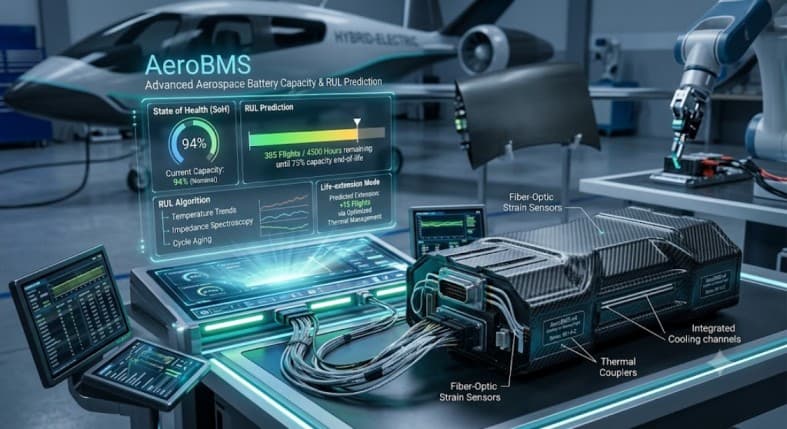
In the aerospace industry, battery reliability is not just a matter of efficiency—it is a critical safety requirement. Sudden drops in battery capacity or miscalculations in Remaining Useful Life (RUL) can lead to catastrophic mission failures. Traditional battery management systems often rely on static voltage thresholds, ignoring the complex, non-linear degradation patterns caused by extreme operational cycles.
This Deep Dive explores AeroBMS, a data-driven Battery Management System. By leveraging machine learning over traditional physics-based models, AeroBMS analyzes historical charge/discharge cycles to provide highly accurate, predictive insights into battery health, ensuring maximum reliability for aerospace operations.
Project Vision
The objective was to architect a production-ready AI solution that goes beyond simple data analysis. I designed AeroBMS to be a modular, end-to-end system: starting from raw telemetry ingestion (01_data_pipeline.py), moving through advanced model training, and culminating in an interactive operational dashboard (dashboard.py) that maintenance crews can use to monitor battery fleets in real-time.
Technical Hurdles
Non-Linear Degradation Patterns: Aerospace batteries exhibit highly complex degradation curves. Capturing these subtle, long-term trends required meticulous feature engineering and time-series restructuring before feeding the data to the models.
Dual-Target Architecture: Predicting current capacity and forecasting future RUL are fundamentally different mathematical tasks. The challenge was designing a unified pipeline capable of training, tuning, and serving two distinct predictive models simultaneously without cross-contamination.
System Architecture
To maintain a clean separation of concerns and ensure enterprise-grade scalability, the AeroBMS repository is structured around three core engineering pillars:
1 Automated Data Pipeline
ETL Processing: The 01_data_pipeline.py script acts as the backbone, autonomously extracting raw telemetry from the master dataset, cleaning noise, scaling features, and generating the engineered features required for the XGBoost algorithms.
2 Dual XGBoost Modeling
Capacity Model (xgboost_capacity_model.json): A highly tuned gradient boosting regressor dedicated to estimating the exact current capacity of the battery based on instantaneous voltage, current, and temperature readings.
RUL Model (xgboost_rul_model.json): A secondary XGBoost architecture optimized for longitudinal forecasting, estimating exactly how many operational cycles remain before the battery hits its critical failure threshold.
3 Operations Dashboard
Interactive Visualization: The dashboard.py application consumes the predictive outputs and raw data to render a comprehensive control panel. It visualizes degradation curves, current health scores, and critical RUL alerts, translating complex ML outputs into actionable insights for engineers.
Performance Evaluation
High-Fidelity Predictions: Both XGBoost models achieved exceptional accuracy, significantly reducing the Mean Absolute Error (MAE) compared to baseline heuristic approaches.
Lightweight Inference: By saving the trained models in native JSON format, the system ensures rapid, lightweight inference, making it highly suitable for future deployment on edge hardware within an aircraft.
Key Takeaways & Tech Stack
AeroBMS proves that gradient boosting frameworks like XGBoost are incredibly powerful for industrial predictive maintenance when paired with rigorous data engineering. Structuring the project into distinct pipeline, modeling, and dashboarding modules ensures the codebase remains maintainable and ready for continuous integration (MLOps).
Languages & Frameworks: Python, Streamlit/Dash (for the dashboard interface).
Machine Learning: XGBoost, Scikit-Learn.
Data Processing: Pandas, NumPy, Jupyter Notebooks.