
Global Sustainable Energy Intelligence System: AI for Climate Action
As the world faces unprecedented climate challenges, transitioning to sustainable energy sources is no longer optional. However, tracking global progress, forecasting future emissions, and objectively comparing the sustainability efforts of different nations requires analyzing massive, highly complex datasets across decades of historical records.
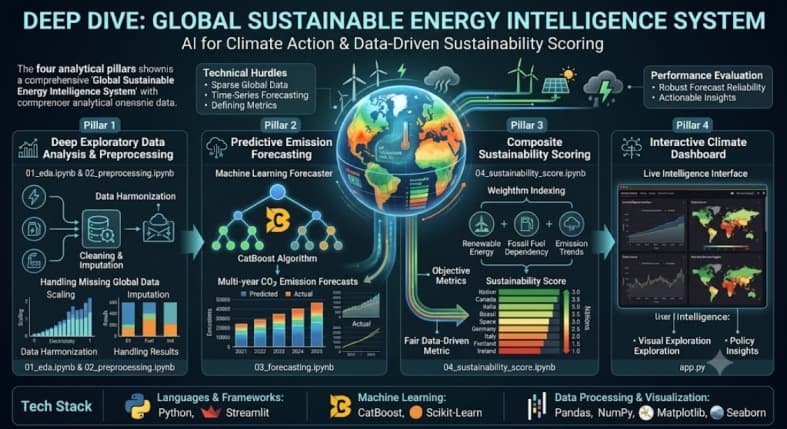
This Deep Dive explores our Global Sustainable Energy Intelligence System. Moving beyond simple descriptive statistics, we architected a predictive machine learning pipeline that ingests global energy metrics to forecast future CO2 emissions and generates a unified, data-driven \"Sustainability Score\" for every country.
Project Vision
Our goal was to build an analytical engine capable of translating raw, multi-national energy data into actionable climate intelligence. We designed the workflow to clean heterogeneous datasets, model long-term emission trends using advanced forecasting algorithms, and deploy these insights into an interactive dashboard for policymakers, researchers, and climate analysts.
Technical Hurdles
Sparse & Inconsistent Global Data: Energy reporting standards vary wildly between countries and decades. Handling severe missing values without introducing statistical bias required highly contextual, region-specific imputation strategies during the preprocessing phase.
Complex Time-Series Forecasting: Predicting national CO2 emissions is not a linear problem. The model had to account for sudden macroeconomic shifts, policy changes, and the exponential adoption rates of renewable technologies.
Defining Objective Metrics: Creating a single \"Sustainability Score\" requires balancing multiple conflicting variables (e.g., GDP growth vs. carbon footprint vs. renewable energy capacity) into a mathematically sound, normalized composite index.
System Architecture
The intelligence system is built upon four robust analytical pillars, transitioning data from raw CSVs to a deployed interactive interface:
1 Deep Exploratory Data Analysis & Preprocessing
Data Harmonization (01_eda.ipynb & 02_preprocessing.ipynb): Conducted extensive spatial-temporal analysis to identify missing data patterns. Engineered an automated pipeline to scale, normalize, and impute decades of global energy and economic metrics, preparing a clean foundation for modeling.
2 Predictive Emission Forecasting
Machine Learning Forecaster (03_forecasting.ipynb): Utilized advanced regression models (like CatBoost) to learn the complex relationships between energy mix variables and carbon output, generating highly accurate, multi-year CO2 emission forecasts for various nations.
3 Composite Sustainability Scoring
Algorithmic Indexing (04_sustainability_score.ipynb): Developed a custom algorithmic scoring system that weighs a nation's renewable energy generation against its fossil fuel dependency and overall emission trends, assigning a quantifiable sustainability rank to every country.
4 Interactive Climate Dashboard
Live Intelligence Interface (app.py): Deployed the serialized models (co2_model.pkl) and processed datasets into a dynamic Streamlit application. The dashboard allows users to visually explore global trends, compare country scores, and interact with emission forecasts in real-time.
Performance Evaluation
Robust Forecast Reliability: The predictive models successfully captured the non-linear dynamics of energy transitions, providing low-error estimations of future CO2 levels across both developing and developed nations.
Actionable Insights: The composite sustainability scoring algorithm successfully normalized global data, offering a fair, data-driven metric that highlights true climate leaders versus laggards.
Key Takeaways & Tech Stack
This project demonstrates that data science is a vital tool for global climate action. By applying rigorous machine learning pipelines to energy datasets, we can move beyond historical observation into proactive climate forecasting, providing the intelligence needed to accelerate the sustainable energy transition.
Languages & Frameworks: Python, Streamlit.
Machine Learning: CatBoost, Scikit-Learn.
Data Processing & Visualization: Pandas, NumPy, Matplotlib, Seaborn.