
End-to-End AI Predictive Maintenance: Real-Time RUL Estimation
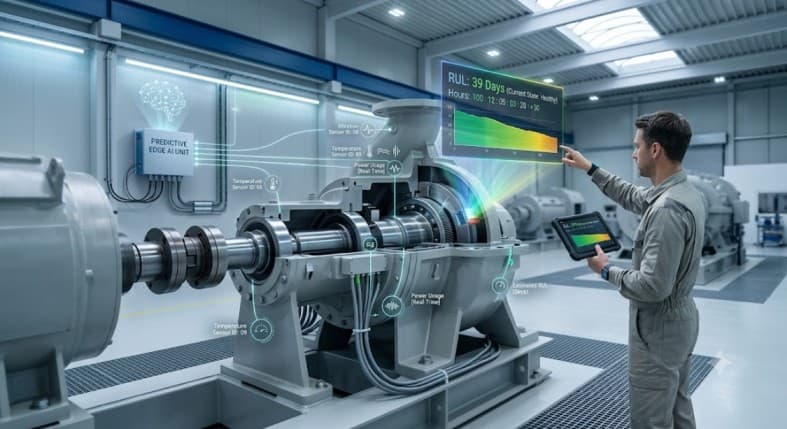
In heavy industries such as aviation and manufacturing, unexpected equipment failure is not just an inconvenience—it translates to millions of dollars in downtime and severe safety risks. Traditional maintenance relies on rigid, time-based schedules (preventative maintenance) or waiting for a machine to break (reactive maintenance).
This Deep Dive explores the architecture of an intelligent Predictive Maintenance System designed to transition operations from reactive to proactive. By leveraging multi-sensor temporal data and advanced machine learning models, this system accurately forecasts the Remaining Useful Life (RUL) of industrial components before catastrophic failure occurs.
Project Vision
The goal was to build more than just a Jupyter Notebook model. I aimed to architect a complete, end-to-end industrial AI pipeline. This meant developing robust predictive models (using XGBoost and Keras Neural Networks), packaging them into a high-performance REST API, and creating an interactive dashboard that could visualize live, streaming sensor data simulating real-world factory conditions.
Technical Hurdles
- Handling Noisy Temporal Data: Industrial sensors (like those in the CMAPSS turbofan dataset) are extremely noisy. Extracting meaningful degradation patterns required complex sliding-window techniques and feature scaling.
- Real-Time Inference Constraints: An industrial dashboard needs sub-second latency. Balancing the depth of the neural network with the execution speed required for live stream prediction was a major architectural challenge.
- Simulation of Live Environments: Creating a Python-based streaming script to mimic MQTT or industrial IoT protocols feeding data sequentially to the FastAPI backend.
System Architecture
To ensure scalability and separation of concerns, the project was structured into four distinct engineering pillars:
1 Data Engineering & Sensor Simulation
- Engineered a custom data loader for the CMAPSS trajectory datasets (FD001-FD004).
- Developed
stream_data.pyto act as an edge-device simulator, continuously pushing live sensor metrics to the backend, mimicking a real operational turbine.
2 Hybrid AI Modeling
- XGBoost Regressor: Deployed for its unparalleled accuracy on tabular temporal features and its resistance to overfitting.
- Deep Learning (Keras): Built sequential neural networks capable of learning deep, non-linear degradation curves from multi-sensor arrays.
3 High-Performance Backend (FastAPI)
- Architected a robust, asynchronous API using FastAPI to serve the trained models (
rule_model.keras). - Implemented endpoints for both batch processing and real-time RUL inference, ensuring the backend could handle concurrent industrial data streams.
4 Interactive Operations Dashboard
- Built a dynamic Streamlit application to serve as the control room interface.
- The dashboard consumes the FastAPI endpoints to visualize live sensor telemetry, degradation curves, and real-time RUL alerts for maintenance crews.
Performance Evaluation
- Successfully minimized the Root Mean Square Error (RMSE) across complex testing sets.
- Achieved ultra-low latency API responses, making the system viable for real-time Edge AI deployments.
- The hybrid modeling approach successfully generalized across different operational conditions and fault modes present in the dataset.
Key Takeaways & Tech Stack
This project demonstrates that deploying AI in industrial settings requires a holistic approach. A highly accurate model is useless without a reliable data streaming pipeline and a scalable inference engine. The integration of modern data science tools with robust backend engineering is the key to actionable AI.
- Languages & Frameworks: Python, FastAPI, Streamlit
- Machine Learning: Scikit-Learn, XGBoost, TensorFlow/Keras
- Data Manipulation: Pandas, NumPy