
Epileptic Seizure Recognition System
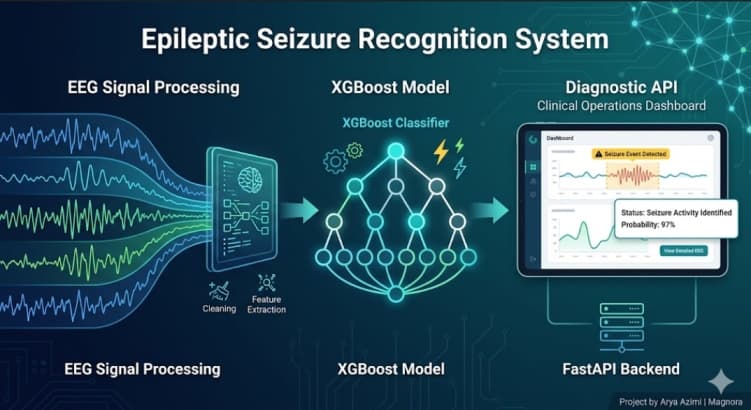
Electroencephalogram (EEG) recordings are a primary tool for diagnosing neurological conditions, yet manually reviewing these extensive signals for seizure activity is highly time-consuming. Automating this process with AI can significantly enhance diagnostic speed and accuracy.
This Deep Dive introduces the Epileptic Seizure Recognition system, an advanced machine learning pipeline developed by the Magnora team and engineered by Arya Azimi. By analyzing thousands of EEG data points, this project deploys a highly optimized model to instantly classify brain activity and identify seizure events.
Project Vision
The goal was to transition from raw, complex EEG signals to a streamlined clinical tool. We aimed to build a high-performance classification engine capable of distinguishing seizure activity from normal brain functions, wrapped within a user-friendly diagnostic dashboard for medical professionals.
Technical Architecture
The pipeline is structured for both clinical accuracy and real-time processing speed, built upon the following engineering pillars:
1 EEG Signal Processing
Exploratory Data Analysis (01_training_and_eda.ipynb): The foundation of the project involved processing the Epileptic Seizure Recognition dataset. We structured and analyzed non-linear EEG readings, extracting crucial temporal features required for accurate neurological classification.
2 Gradient Boosting Classifier
XGBoost Model (models/xgboost_seizure_model.pkl): We utilized an XGBoost algorithm to handle the high-dimensional nature of EEG data. The model was aggressively trained and tuned to detect the specific brainwave patterns associated with epileptic seizures, resulting in a highly accurate, serialized inference engine.
3 Diagnostic API
FastAPI Backend (app/main.py): To ensure the model is accessible for clinical applications, it is deployed via an asynchronous REST API. This backend handles incoming EEG data streams and returns instantaneous diagnostic predictions.
4 Clinical Operations Dashboard
Interactive Interface (app/dashboard.py): A responsive Streamlit dashboard was developed to serve as the front-end interface. Clinicians can upload sample EEG data (dashboard_sample.csv) to visualize signal patterns and receive immediate seizure probability assessments.
Key Takeaways & Tech Stack
This project highlights the profound impact of machine learning in neurology. By coupling XGBoost with a modern web stack, the Magnora team provides a blueprint for real-time, AI-assisted medical diagnostics.
Languages & Frameworks: Python, FastAPI, Streamlit.
Machine Learning: XGBoost, Time-Series Classification, Predictive Modeling.
Data Processing: Pandas, NumPy, Scikit-Learn.