
Fetal Health AI Classification System
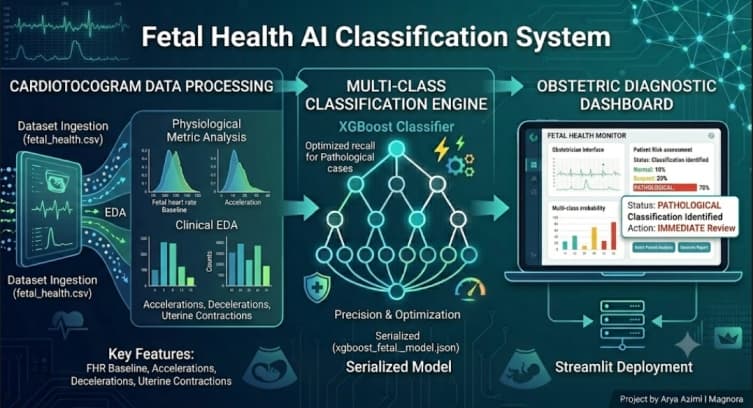
Monitoring fetal health during pregnancy is a critical component of maternal care. Cardiotocograms (CTGs) provide continuous data on fetal heart rate and uterine contractions, but their manual interpretation can be subjective and time-consuming.
This Deep Dive explores the Fetal Health AI Classification system, a clinical machine learning tool proudly developed by the Magnora team and engineered by Arya Azimi. By analyzing physiological metrics extracted from CTG exams, this pipeline autonomously classifies fetal health states, providing obstetricians with a rapid, data-driven diagnostic second opinion.
Project Vision
The primary objective was to architect a highly reliable multi-class predictive engine capable of distinguishing between Normal, Suspect, and Pathological fetal conditions. We aimed to deliver this complex AI model through a highly accessible dashboard, ensuring medical professionals can leverage advanced analytics without friction.
Technical Architecture
The system was designed with clinical precision and ease of use in mind, structured across three key engineering pillars:
1 Cardiotocogram Data Processing
Clinical EDA (01_training_and_eda.ipynb): The development began with rigorous exploratory data analysis on the fetal_health.csv dataset. We analyzed critical features like baseline heart rate, accelerations, and decelerations to map out the physiological markers most indicative of fetal distress.
2 Multi-Class Classification Engine
XGBoost Predictive Model (models/xgboost_fetal_model.json): We deployed an advanced XGBoost classifier optimized for multi-class clinical predictions. The model was fine-tuned to maximize recall for pathological cases, ensuring high-risk conditions are never missed, and serialized into JSON for rapid deployment.
3 Obstetric Diagnostic Dashboard
Interactive Interface (app/dashboard.py): To bridge the gap between machine learning and medical practice, we built a responsive Streamlit application. Clinicians can input vital metrics or upload batch patient data (dashboard_sample.csv) to instantly view health classifications and underlying risk probabilities.
Key Takeaways & Tech Stack
This project illustrates the transformative power of AI in maternal-fetal medicine. By providing an automated layer of CTG analysis, the Magnora team delivers a scalable solution to support early intervention and improve perinatal outcomes.
Languages & Frameworks: Python, Streamlit.
Machine Learning: XGBoost, Multi-Class Classification, Clinical Analytics.
Data Processing: Pandas, NumPy, Scikit-Learn.