
Real-Time Energy Telemetry & AI Forecasting System
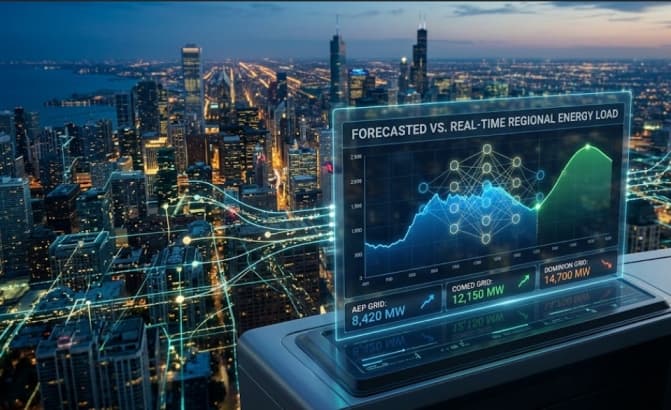
The transition toward smart grids demands highly accurate predictive analytics to optimize energy distribution and mitigate outages. Traditional statistical models often fail to capture the complex, non-linear patterns inherent in regional power consumption.
This Deep Dive explores the Real-Time Energy Telemetry & AI Forecasting project, proudly developed by the Magnora team and created by Arya Azimi. By leveraging advanced machine learning algorithms and real-time telemetry data from the PJM Interconnection grid, this end-to-end pipeline forecasts hourly energy consumption across multiple regions with exceptional precision.
Project Vision
Our primary objective was to build a robust predictive analytics system capable of ingesting massive streams of raw energy telemetry and translating them into actionable, real-time forecasts. The vision was to empower energy grid operators with a scalable AI solution to anticipate demand spikes and optimize energy loads dynamically.
Technical Architecture & Workflow
The system is meticulously structured into a modular pipeline, ensuring seamless data processing, model training, and deployment. The project is divided into logical engineering phases:
1 Data Ingestion & Exploratory Data Analysis
Raw Telemetry Processing (01_eda.ipynb): We utilized extensive historical datasets from various PJM grids, including AEP, COMED, DAYTON, DEOK, DOM, DUQ, EKPC, FE, NI, PJME, and PJMW. The initial phase involved deep exploratory data analysis to understand seasonal trends, cyclical behaviors, and anomalies in hourly energy consumption.
2 Feature Engineering
Temporal Optimization (02_feature_engineering.ipynb): To capture the intricacies of energy demand, we engineered specialized temporal features. This included extracting hour-of-day, day-of-week, and holiday indicators, transforming raw CSV and Parquet timestamps into powerful predictive signals.
3 Model Training & Predictive Analytics
AI Forecasting (03_training.ipynb & 04_evaluation.ipynb): We trained dedicated machine learning models for each specific grid region. The optimized models were then serialized into individual files (e.g., AEP_forecast.pkl, COMED_forecast.pkl, energy_forecast.pkl) for rapid inference. Rigorous evaluation metrics were applied to ensure highly accurate forecasting.
4 Interactive Dashboard Deployment
Real-Time Web Application (app/app.py): To make the forecasting engine accessible and user-friendly, we developed a responsive web application. The dashboard seamlessly loads the pre-trained .pkl models from the models directory to deliver real-time load predictions to end-users.
Key Takeaways & Tech Stack
This project showcases the transformative power of Artificial Intelligence in the energy sector. By integrating predictive analytics with smart grid telemetry, the Magnora team provides a scalable blueprint for next-generation energy management.
Languages & Frameworks: Python, Streamlit, Scikit-Learn.
Machine Learning: Predictive Analytics, Time-Series Forecasting, Regression Models.
Data Processing: Pandas, NumPy, Parquet.